
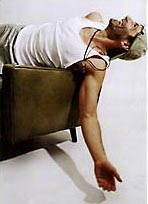
 Interview: Stevie
Jay
Interview: Stevie
Jay
Your show, Life,
Love, Sex, Death ... and other works in progress, is about to open in London.
How do you imagine British audiences will react to your show compared with
American audiences? We're supposed to be a bit more uptight, after all.
I really don't know what to expect in that regard. Maybe I'll need to
revise my script to include British colloquialisms like, "Fuck off, you
wankers!! Bloody hell! Am I being cheeky? Don't mind me, I'm just taking
the piss!" I'll have to play that one by ear.
The play seems to deal with a spectrum of issues, including, in your
words. 'the endless struggle to remain spiritually oriented and irresistibly
gorgeous at all times.' Tell us more about that.
The core theme of the show explores the struggles we all go through as
human beings, to live our lives honestly and passionately—to love fearlessly,
to risk rejection, and to reach out to people we're attracted to even
when we're scared. We all want to connect with spirit, whether we know
this consciously or not, and at the same time, we all want to keep our
lower halves well-fed. (We're usually conscious of that part.) This often
presents a dilemma, as the inter-relatedness of the two is an elusive
concept for many people. It is my feeling that while we're here in these
bodies, we're meant to find a way to make all these different parts work
together. In terms of sex, that's just one of many ingredients to be mixed
in with the batter, not to be fragmented, and not to be turned into one's
entire existence either. Hopefully, sex will reside somewhere in the middle
of one's life. (Somewhere in the middle of my DAY would be kind of nice,
actually; lunch time, preferably.) My show offers a glimpse of embracing
the whole of oneself—the good, the bad, and the ugly—and letting it
all be okay.
Your show is part of a season presented by Theatre 28—a company that
has developed a strong reputation for gay theatre. Do you think you'd
make your show different if it was part of a 'straight' season?
You know, whenever I hear that term "gay theatre," I immediately think
we're talking about the Special Olympics or something. No offense, but
unless we're discussing a fisting show at The Mine Shaft or some such
venue, a play is just a play, even if the main characters do happen to
be two guys or two gals who are intimately involved. I suppose there
are folks out there who regard A Raisin in the Sun as "black
theatre" or Fiddler on the Roof as "Jewish theatre," but as far
as I'm concerned, theatre is just theatre, regardless of any non-Caucasian, non-Anglo-Saxon, not strictly heterosexually-active, other-than-Protestant individuals who
may be portrayed within the storyline. Don't mind me, I'm just taking
the piss.
Do you think that gay men have a problem with relationships?
I don't really think in terms of gay and straight—I think that people
are people, and with that, I would say that most people have
a problem with relationships, and get themselves way above their heads
in terms of what they can actually commit to in a relationship. More times
than not, once the shit hits the fan, and fantasy time is over, the impulse
to bolt is strong. These quick exits are often rationalised with phrases
such as: "This just isn't the right person," when the truth is, "This
just isn't fun anymore. I'm outta here!
So whether you're involved in a same-sex relationship or an opposite
sex combo, it is inevitable if you get close, that your buttons will be
pushed and your unresolved Mommy-Daddy issues will come flying up and
smack you in the face!
There is, however, something to be said on the subject of men.
It has become a cultural norm, in the Western hemisphere, at least, for
men to be emotionally absent and non-expressive. So when two men get together
in any context, there is the greater possibility of an unwillingness to
communicate openly.
How does your life at the gym fit into your show?
One of the most revealing segments of the show is a reenactment of an
excruciating encounter I had at the gym—a moment of insanity in which
I actually attempted to reach out and break through The Testosterone Wall.
It's an audience favorite, for sure.
What's most impressive about my chest is how realistic those guys on
the make-up crew were able to get my pectoral prosthetics to look for
the photo shoot!
You've said before that your formula for success is to make sure you
are "baring your soul at all times." Do you ever feel you're being too
open, and has it ever gotten you into trouble?
There are definitely times it would behoove me to pull up the drawbridge
a bit. On the other hand, one is simply
living dead when one's heart is closed. Rumi, the 12th Century Persian
poet says: 'Gamble everything for love, if you're a true human being;
if not, leave this gathering. Half-heartedness doesn't reach into majesty.'
What do you hope your audiences go home thinking about after your
show?
I hope people will come away from the show remembering that we don't
have forever to live—that we will, indeed, be gone one day. And that
beyond everything else, we are human beings first. Hopefully, we will
love and respect each other deeply and create safety in the world wherever
we can, because at the end of our lives, these are the things that will
matter to us: love, safety, respect. These are the things that matter
now. So let's not miss it...while we're still here.
Finborough Theatre, 1-26 May
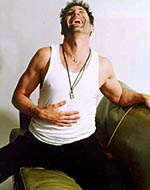 You've said that whipping
off your shirt and baring your chest is a sure-fire winner every time.
Is your chest really that impressive?
You've said that whipping
off your shirt and baring your chest is a sure-fire winner every time.
Is your chest really that impressive?
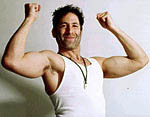 Stevie Jay: Life, Love,
Sex, Death...and other works in progress
Stevie Jay: Life, Love,
Sex, Death...and other works in progress